 Skip to content

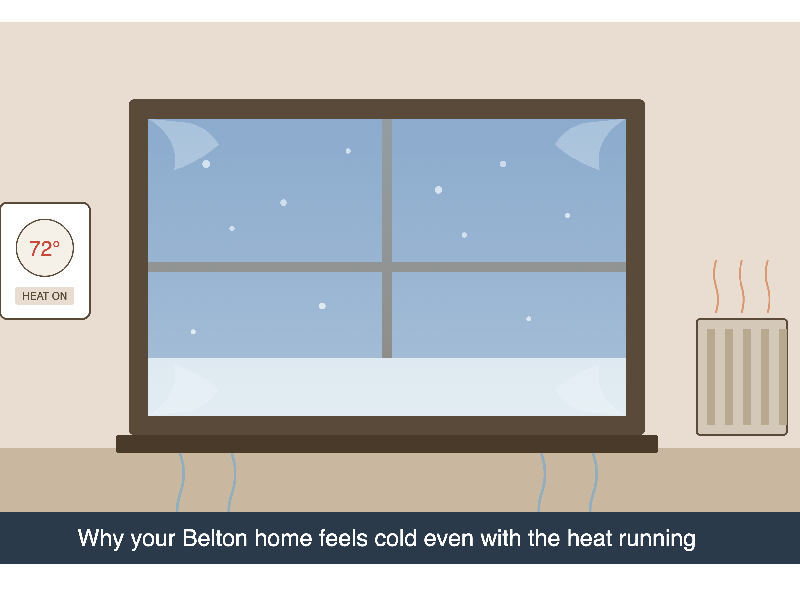
Your thermostat reads 72°, but your toes tell a completely different story.
You find yourself pulling on thick wool socks, wrapping up in a heavy throw blanket, and wondering why on earth the furnace is running non-stop while you are shivering on the sofa.
People outside of Central Texas think our winters are pure sunshine. We know better. A sharp northern cold front can slam through Belton overnight, dumping temperatures straight into the 20s. Most houses across Bell County were framed, sided, and insulated with one primary objective: survive July and August. They dump heat well. The problem is they keep dumping heat in January when you are desperately trying to hold onto it.
If your home feels like an icebox despite the heater humming along, warm air is escaping somewhere. Here are five suspects behind the chill, along with the single project that finally puts an end to it.
1. Drafty, Failing Windows (The Number One Offender)
Go touch the glass in your living room right now. If it feels like an ice cube, you have found the main leak.
According to ENERGY STAR data, heat leaking through outdated windows accounts for 25% to 30% of average residential heating costs. Think about that for a second. A quarter of your heating bill is walking right out through the glass.
In older neighborhoods around Belton, like Miller Heights, Three Creeks, or the older ranch layouts down by Nolan Creek, houses built through the 1980s and 1990s usually feature cheap aluminum-frame units. Aluminum acts like a thermal highway, pulling freezing outdoor temperatures directly into your wall cavities.
Watch for these dead giveaways:
- Hold your hand against the glass: If the pane radiates cold, the glass is cooling the air right next to it. That cold air drops to the floor, setting up a continuous, invisible breeze that sweeps across your feet.
- Fog between the glass layers: That hazy moisture trapped inside double panes means the perimeter seal failed. The insulating gas escaped, leaving you with dead air space that does nothing to stop the freeze.
- Drapes that twitch: When the wind blows outside and your closed blinds move on their own, outside air is leaking straight past the sash.
- Crumbling caulk and gaps: Sunlight peeking through frame corners means outside air is whistling right into the drywall.
When glass and frames degrade, installing modern replacement windows in Belton, TX stops that air transfer dead in its tracks.
2. Air Leaks at Doors and Baseboards
Windows take the brunt of the blame, but exterior doors and ground-level trim run a close second.
Central Texas soil expands when it rains and shrinks when it dries out. That constant shifting twists door frames over the years. Foam weatherstripping rots in the summer heat, and rubber door sweeps tear away from heavy foot traffic.
Try this test tonight: light an incense stick or a small candle. Walk slowly along your front entryway, your patio sliders, and your baseboards on exterior-facing walls. If the smoke pulls hard or the flame flickers sideways, you are standing in an air leak.
Replacing rotted weatherstripping or screwing on a heavy-duty silicone bottom sweep costs very little and takes an hour on a Saturday. For old hollow-core wood doors that have warped out of square, though, simple strips will not cut it. The whole door assembly will need to come out.
3. An Under-Insulated Attic
Heat rises. It is basic physics. If your attic lacks adequate coverage, every dollar coming out of your furnace vents drifts straight up through the ceiling sheetrock and vents into the night sky.
The Department of Energy sets standards for our climate zone (Zone 2) at R-38 to R-60. In plain English, you want roughly 12 to 18 inches of fluffy fiberglass or blown cellulose up there. Climb up the attic stairs with a tape measure. In many older Belton builds, that old blown-in insulation has packed down to a measly four or five inches.
When your attic insulation falls short, you will notice:
- High heating bills that shoot up drastically after just two nights of freezing temperatures.
- Random cold spots where one room feels fine and the guest bedroom down the hall feels like a refrigerator.
- Second-floor bonus rooms or bedrooms sitting over unheated garages that never seem to stay comfortable.
Renting a blower and adding fresh cellulose over existing batts is an easy project that pays you back fast.
4. An Aging or Undersized Heating System
Sometimes the house holds heat reasonably well, but the mechanical system producing it is gasping for air.
Most split systems and heat pumps give you 15 to 20 decent years before mechanical wear catches up. As the internal components degrade, the equipment loses anywhere from 20% to 40% of its operating efficiency.
Beyond an aging compressor or failing heat strips, check the ductwork. If you have flexible ducts snaking across a freezing, unconditioned attic, small tears, loose duct tape, or unsealed joints will bleed up to 30% of your warmed air before it reaches the floor registers.
A word of caution: do not run out and spend $12,000 on a giant new HVAC unit without looking at your walls and windows first. Putting a massive furnace into an unsealed, drafty house is like buying a bigger engine for a car with four flat tires. Seal the shell first.
5. Thermal Bridging in Cold Wall Pockets
Ever stand in front of an exterior wall and feel a persistent chill, even though there are no vents or windows nearby?
That is thermal bridging. Wood studs, solid concrete slabs, and uninsulated header beams above wide window openings conduct cold much faster than an insulated cavity. If your exterior walls have old batt insulation that settled toward the bottom of the stud bay over the last thirty years, you are essentially left with an uninsulated pocket at the top of the wall.
Short of stripping your interior walls down to bare framing, you cannot easily re-insulate the exterior wall cavities. The smart workaround is closing off the major leak points around your room perimeters so cold air stops feeding those temperature drops.
The Fix With the Biggest Return: High-Performance Replacement Windows
Sealing weatherstripping helps around the edges. Adding insulation to the attic keeps rising heat inside. But if your windows remain thin, drafty, and unsealed, your house will never feel truly warm.
Modern window replacement in Belton, TX addresses the fundamental physics of heat transfer:
- Low-E Glass: Specialized coatings bounce internal furnace heat back inside the room during freezing snaps. When August arrives, those same microscopic layers flip the script and reflect scorching solar heat outside.
- Heavy Argon Gas Fills: Trapping dense, non-toxic argon gas between multiple panes dramatically slows thermal exchange compared to regular air.
- Multi-Chambered Vinyl Frames: Unlike old aluminum that sweats and feels cold to the touch, structural vinyl creates closed pockets of dead air that will not conduct the chill into your drywall.
You get far more than a warmer living room:
- Lower summer electric bills: In Texas, air conditioning costs hurt far more than winter gas bills. High-performance glass keeps solar heat from baking your interiors from May through October.
- A quieter home: Thick, double-pane glass dampens barking dogs, highway noise, and neighborhood lawnmowers.
- No more sun-bleached interiors: Quality glass filters out the UV rays that fade hardwood floors, leather armchairs, and expensive area rugs.
Universal Windows Direct Central Texas builds custom UniShield® window packages manufactured specifically for extreme Texas weather swings. We handle every step with local installation crews, and we back the whole project with a True Lifetime Warranty covering the glass, frames, and operating hardware.
Stop Paying to Heat the Outside
You pay good money to keep your home warm. Letting that heat escape through 30-year-old frames and failing seals makes no sense.
Before the next cold front rolls through Bell County, find out exactly where your rooms are losing comfort. Universal Windows Direct Central Texas provides free in-home consultations and straightforward, same-day estimates for homeowners in Belton, Temple, Killeen, Salado, and nearby neighborhoods.
We will walk your home, test your existing units, point out where seals have separated, and explain practical replacement options that fit your budget.