 Skip to content

Step into your west-facing living room at five in the afternoon on a July workday.
The heat hits you like an open oven door.
Outside, the pavement is shimmering at 104°. Inside, your condenser has been screaming in the side yard since noon without taking a breath, but the air in that front room is hovering somewhere around 84°. Your first instinct is to blame the air conditioner. You might even call an HVAC tech to add freon. But nine times out of ten, the equipment is fine. The sun is just pouring straight through your glass.
Waco gets hammered by brutal solar exposure for five straight months. When electric bills spike past $350, standard walls and attics take some of the hit, but unshaded, inefficient glass is the real thermal funnel.
If you want to know how to reduce heat gain windows Waco, TX homes suffer from every single summer, you have to look at the actual physics at play. Here is what works, what falls flat, and where your money goes furthest.
What Is Solar Heat Gain (And Why Does It Punish Waco)?
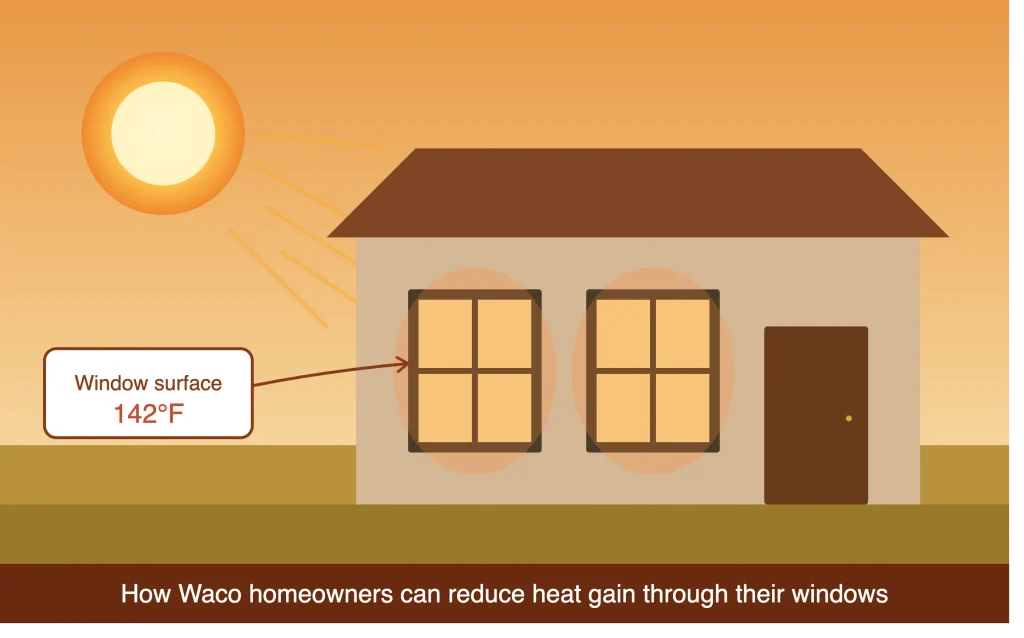
Windows come with a specific efficiency number called the Solar Heat Gain Coefficient (SHGC).
Ignore the fancy engineering label. It just tells you how much raw solar heat passes through the glass on a scale from 0 to 1. A lower number means less heat coming inside to fight your air conditioner.
Single-pane glass (standard in older ranch homes all over Waco) rates around 0.80. That means eighty percent of the sun’s scorching infrared energy travels directly through the pane and bakes your sofa, your floors, and your skin.
Compare that to modern double-pane glass made for Texas, which sits at 0.25 or lower. It blocks three-quarters of that solar load before it ever touches your indoor air.
In northern states, homeowners actually want solar heat to help warm the house in January. In Central Texas (Department of Energy Climate Zone 2), that mindset will bankrupt you on utility bills. You will also see a rating called U-Factor, which measures how well the window stops heat loss during cold snaps. That matters when an Arctic freeze blows down I-35, but for seven months of the year, SHGC is the metric that dictates your summer power bill.
1. Solar Window Film (A Cheap, Fast Patch)
Need immediate relief without tearing anything apart? Aftermarket window film is a decent stopgap.
You stick these polyester sheets straight onto the inside of the glass. Microscopic metallic layers reflect a fair portion of that blinding infrared glare before it turns the room into a greenhouse.
- Expect to spend $5 to $10 per square foot if you install DIY rolls from the hardware store, or up to $15 per square foot for a pro install.
- Decent films bounce back between 30% and 70% of raw solar heat.
- They go up in an afternoon, cost very little upfront, and leave your outdoor view intact.
Here is the catch: Texas sun eats film for breakfast. Give it three or four years and you will see peeling corners, hazy discoloration, and ugly purple bubbles right in the center of the pane. Even worse, trapping heat against modern insulated glass can cook the perimeter seals or crack the glass itself, which immediately voids your manufacturer warranty. It also does nothing for rattling, rotted frames.
Think of film as a renter’s solution, not an investment.
2. Exterior Shading and Heavy-Duty Solar Screens
Basic rule of thumb: stop the sunlight before it touches the glass, and you win half the battle.
Once daylight hits the outer surface of your window, heat starts transferring into your rooms. Blocking that light from the outside is dramatically more effective than hanging curtains on the inside.
- Solar screens: These heavy, vinyl-coated polyester weaves replace the flimsy bug screens on your exterior sills. Placed on west and south walls, dense 80% to 90% screens block the majority of raw solar radiation before it hits the glass.
- Overhangs and awnings: Deep porch roofs or fabric awnings physically cast shadows over the glass during the worst parts of the afternoon.
- Shade trees: Planting a native cedar elm or red oak twenty feet out creates a natural canopy, though you have to wait a decade to reap the benefits.
The downside? Solar screens make your house look dark from the street, and looking out through them feels like wearing cheap sunglasses indoors. Also, if you live in newer subdivisions around Woodway, Hewitt, or China Spring, picky HOA boards often reject dark exterior screens on front-facing elevations.
3. Honeycomb Shades and Thermal Drapes (Better Than Nothing)
If you cannot change the exterior, your next move is interior window coverings.
Cellular (or honeycomb) shades use stacked, hexagonal fabric cells that create little pockets of dead air. That trapped pocket creates a thermal buffer between the searing window pane and your living space, cutting perceived heat transfer by up to 60%. Blackout drapes backed with thick, white thermal lining work similarly by deflecting light back toward the outdoors.
Keep your expectations realistic, though.
By the time sunlight hits your blackout curtain, that heat has already breached the walls of your home. You end up with a pocket of superheated air trapped between the curtain and the glass, which slowly radiates into the room anyway. These treatments take the edge off, but they treat the symptom instead of fixing the hole in your wall.
4. Sealing Frame Gaps (The $25 Weekend Win)
Hold your hand near the edge of the casing on a blustery afternoon. If you feel warm air moving around the trim, glass is only half your problem.
Waco sits on active clay soil. When our ground dries out in late summer, it shrinks, pulling foundations down and racking window frames out of square. That movement cracks exterior caulk, tears old foam weatherstripping, and leaves tiny pathways for 100° air to get sucked right into your wall cavities.
Take a close look for these signs:
- Dirty streaks or dust settling along the interior sill.
- Thin lines of daylight showing through frame joints.
- A soft whistle when the wind picks up from the south.
Grab a caulk gun, a couple of tubes of high-grade exterior elastomeric sealant, and some foam backer rod for wider gaps. Scraping away brittle, dried-out caulk and laying down a fresh, rubbery bead takes two hours on a Saturday, costs less than a tank of gas, and stops hot air from bypassing your windows entirely.
5. Low-E Double-Pane Replacement (The Permanent Solution)
Caulk seals the cracks. Curtains hide the light. But if your home still relies on 30-year-old single-pane glass or warped aluminum frames, you are fighting a losing war.
Old aluminum frames are thermal bridges. Put your hand on an aluminum frame at 4 PM in August and it will literally burn your palm. That metal frame acts like a radiator element, pulling outdoor heat straight through the wall studs and pumping it inside.
Modern window replacement in Waco, TX fixes the actual physics of the opening:
- Microscopic Low-E glass coatings: Specialized silver oxide layers let soft, natural light pass through while actively bouncing long-wave infrared heat back into the yard.
- Hermetically sealed argon gas: Standard air inside glass units circulates and transfers heat. Dense argon gas barely moves, which slows thermal transfer to a crawl and brings your SHGC down to a rock-solid 0.22 to 0.25 range.
- Multi-chamber vinyl frames: Vinyl does not conduct heat. The frame stays room temperature to the touch, killing the thermal bridge completely.
The difference in everyday living is night and day:
- Rooms that used to be unlivable after 3 PM suddenly match the rest of the house.
- Summer cooling bills routinely drop 20% to 30%, which puts serious money back in your pocket during July, August, and September.
- Your air conditioner stops short-cycling and finally gets a break, adding years to the lifespan of an expensive compressor.
Universal Windows Direct Central Texas builds custom UniShield® window packages manufactured specifically to hold up against Texas heat waves. Our local installation crews do not cut corners, and every window comes backed by a True Lifetime Warranty that covers the vinyl, the glass seal, and the mechanical hardware.
6. The Rest of the Thermal Shell
Windows are the single biggest hole in your defense, but your home is an interconnected box.
If you install top-tier windows while ignoring your roof space, you are only doing half the job. Stick your head up into the attic hatch with a flashlight. If you see the tops of the ceiling joists, you do not have enough insulation. Blown-in fiberglass or cellulose should sit 12 to 14 inches deep to stop 140° attic heat from baking down through your ceiling sheetrock.
Check the flexible ducts while you are up there, too. If joints are leaking, your blower is pulling superheated attic air straight into your cold supply registers.
Fixing those duct leaks and topping off your attic insulation alongside new windows locks down your entire building envelope.
Keep the Texas Sun Outside Where It Belongs
You should not have to live in a dark cave with every blind pulled shut just to survive a Central Texas summer.
Stop letting old, leaky glass dictate how comfortable you feel in your own home. Universal Windows Direct Central Texas provides clear, no-pressure in-home assessments and exact pricing for homeowners in Waco, Hewitt, Woodway, China Spring, Robinson, and surrounding areas.
We will inspect your current frames, test your glass for seal failures, and show you exactly what it takes to keep your house cold when the Texas sun is at its worst.